


















Welcome to the staging ground for new communities! Each proposal has a description in the "Descriptions" category and a body of questions and answers in "Incubator Q&A". You can ask questions (and get answers, we hope!) right away, and start new proposals.
Are you here to participate in a specific proposal? Click on the proposal tag (with the dark outline) to see only posts about that proposal and not all of the others that are in progress. Tags are at the bottom of each post.
Comments on Tiling a 6x9 rectangle using two types of L-shapes
Parent
Tiling a 6x9 rectangle using two types of L-shapes Question
In the diagram below, there are two types of L-shaped pieces (one made of 5 unit squares and the other made of 7 unit squares). The goal is to tile a 6x9 rectangle with one or more of the smaller L’s and one or more of the larger L’s.
You are allowed to rotate the L’s.

Arithmetic hint. Click/tap here to reveal
A 6x9 rectangle has total area of 54 unit squares.
If X is the number of L’s made of 5 unit squares and
If Y is the number of L’s made of 7 unit squares,
Then 5X + 7Y must equal 54.
Visual hint. Click/tap here to reveal
There is a symmetrical solution to this puzzle with an L-shaped piece placed as shown in the diagram below:


Post
I enjoyed this puzzle. Each step follows naturally from the last until the rectangle is filled.
Reasoning
- Putting a large L in a corner leads to a sequence of placements that unavoidably fill a 4 by 6 rectangle, leaving a 5 by 6 rectangle to be filled. This requires 30 squares, which can only be 6 small Ls, which do not fit. Each corner therefore has a small L. Their corners must be in the corners of the rectangle otherwise progress quickly becomes impossible.
- This leaves spaces of height 4 on the left and right which must be filled by large L's otherwise all subsequent placements leave gaps. One of the large L's must be rotated 180 degrees relative to the other otherwise they will overlap.
- The resulting spaces at the top and bottom cannot accommodate a large L, and can only accommodate a small L in one orientation.
- This leaves 2 spaces the exact size and shape of a small L.
Solution
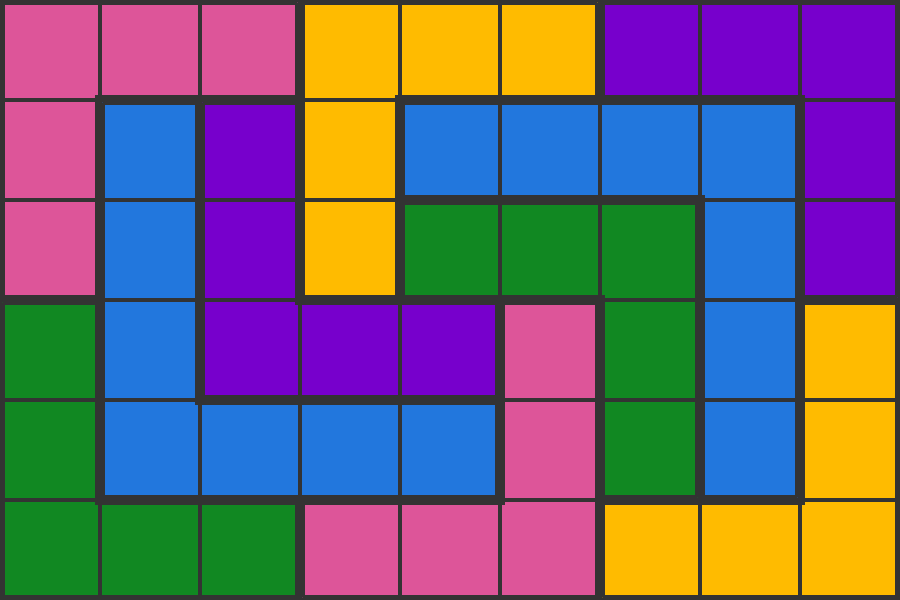
Animation
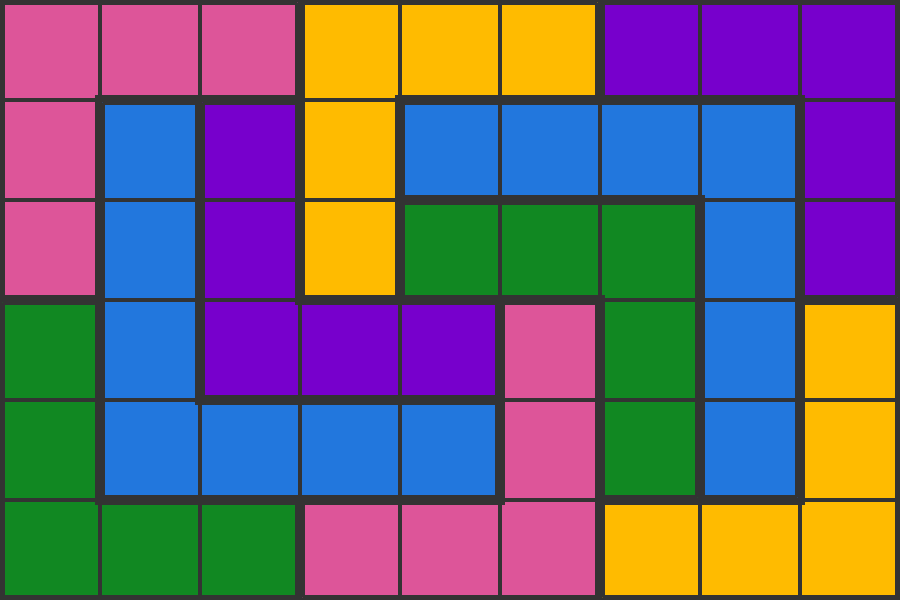
I believe this is the only possible solution (apart from its mirror reflection).


0 comment threads